How did the Islands in Lake Champlain Form?
This Lake Log entry was contributed by 2025 Education and Outreach Steward Mia Handte-Reinecker.
The Champlain Islands are more than just beautiful landforms; they are living records of ancient oceans, tectonic collisions, and powerful glaciers. Their exposed bedrock tells a story that stretches back nearly half a billion years, reminding us that the landscape we see today was shaped by forces far older and larger than ourselves.
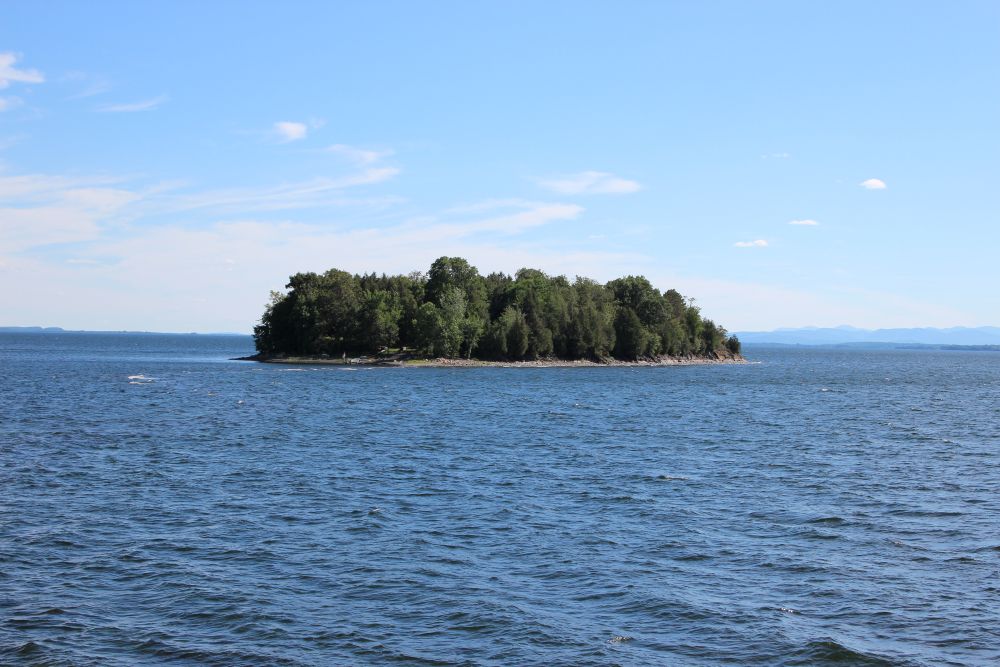
The story begins about 450–480 million years ago, during the Ordovician Period. What would later be the Champlain Basin was located near the equator and submerged beneath a vast ocean called the Iapetus Ocean. This predecessor of the Atlantic Ocean stretched thousands of kilometers and was filled with marine life, including coral, trilobites (hard-shelled, bug-like creatures), and brachiopods (visually appeared like clams).
As these organisms lived and died, calcium-rich sediments from their shells and skeletons accumulated on the ocean floor. Layers of sediment built up and pressed down on each other. Pressure from the weight of these accumulating sediments and minerals in the water helped cement the particles together. This process, called lithification, slowly turned the sediments into solid rock, eventually forming the bedrock of the Champlain Islands.
The Iapetus Ocean was large, resulting in various types of sedimentary rock developing throughout the different areas of the Ocean. The islands themselves are primarily made of limestone, dolostone, and shale:
- Limestone formed in warm, shallow marine environments like reefs.
- Dolostone formed when limestone was later chemically altered by magnesium-rich water. This makes the rock more resistant to erosion.
- Shale formed from fine mud in deeper, quieter waters.
Around 440–350 million years ago, tectonic forces closed the Iapetus Ocean. Continental collisions during the Taconic and Acadian Orogenies pushed and deformed the region’s rock layers. One visible sign of this geologic stress is the Champlain Thrust Fault, a line running from Quebec to the Catskill Plateau in New York, where the older rock was pushed over younger rock. The Islands were less affected due to their location to the west of the fault, but some of the rocks beneath the islands were tilted or uplifted during this time.
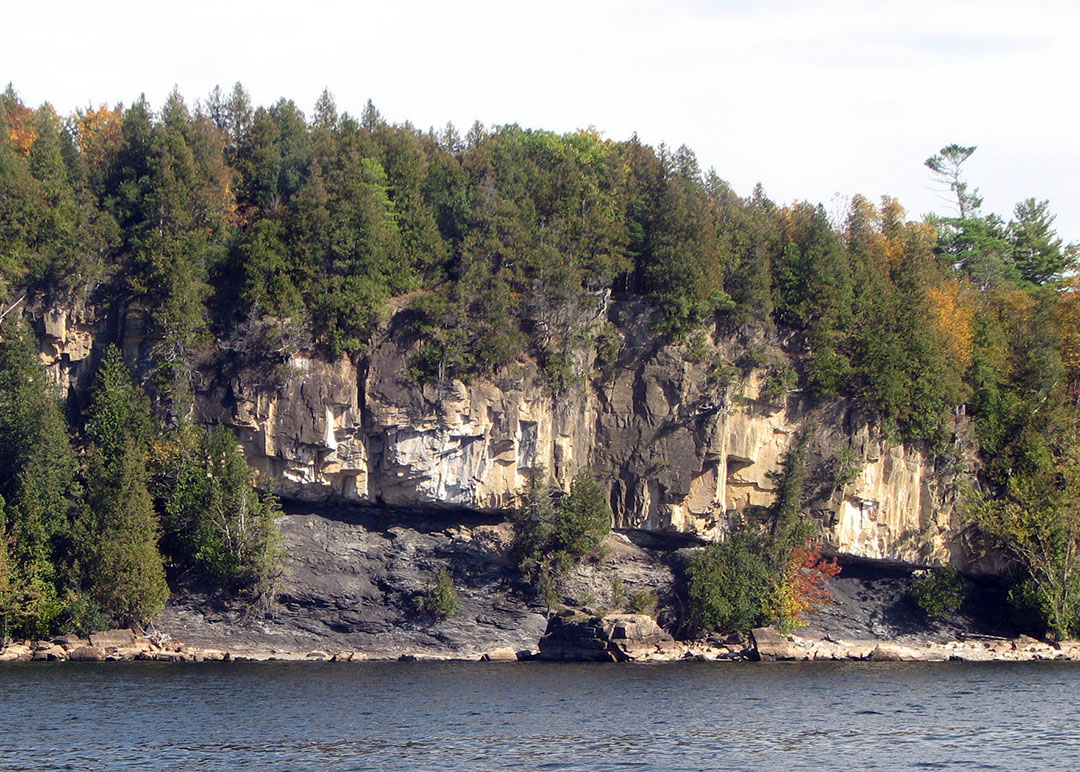
For hundreds of millions of years after that, the Champlain Valley remained mostly above sea level. It was likely mountainous and home to diverse plant and animal life. Over time, erosion wore down the mountains, and little to no new sedimentary rock was deposited in the region.
Fast forward to about 20,000 years ago: an Ice Age! The Champlain Valley (and the future islands) were buried for about 10,000 years under a dynamic glacier called the Laurentide Ice Sheet.
As the glacier advanced and retreated, it scraped, carved, and reshaped the land beneath it. Where the bedrock was soft (like shale) the glacier carved deep valleys. Where the bedrock was hard (like dolostone) the glacier smoothed and polished the surface. The Champlain Islands are the exposed summits of these more erosion resistant bedrock ridges.
On some of the Champlain Islands, even softer limestone managed to survive the glacier’s force. One striking example is the Chazy Reef that is exposed on Isle La Motte. It is one of the oldest known fossilized coral reefs in the world, dating back about 480 million years. It formed in the shallow, tropical waters of the Iapetus Ocean and is composed of densely packed corals and other marine organisms. Although limestone is usually more prone to erosion than dolostone, this reef limestone is unusually strong due to its interlocked fossil structure. Additionally, uneven glacial pressure and the shape of the land beneath the ice may have helped shield it from the most impactful forces of glacial scouring.

When the Laurentide Ice Sheet began melting about 13,000 years ago, the valleys—created when the weight of the glacier depressed the landscape—filled with water creating Glacial Lake Vermont. The Laurentide Ice sheet continued to retreat and impact land, eventually creating a deep valley connecting Glacial Lake Vermont to the ocean and filling it with saltwater. Glacial Lake Vermont, now a mix of ocean salt water and glacial melt, shifted to a large-inland sea known as the Champlain Sea.
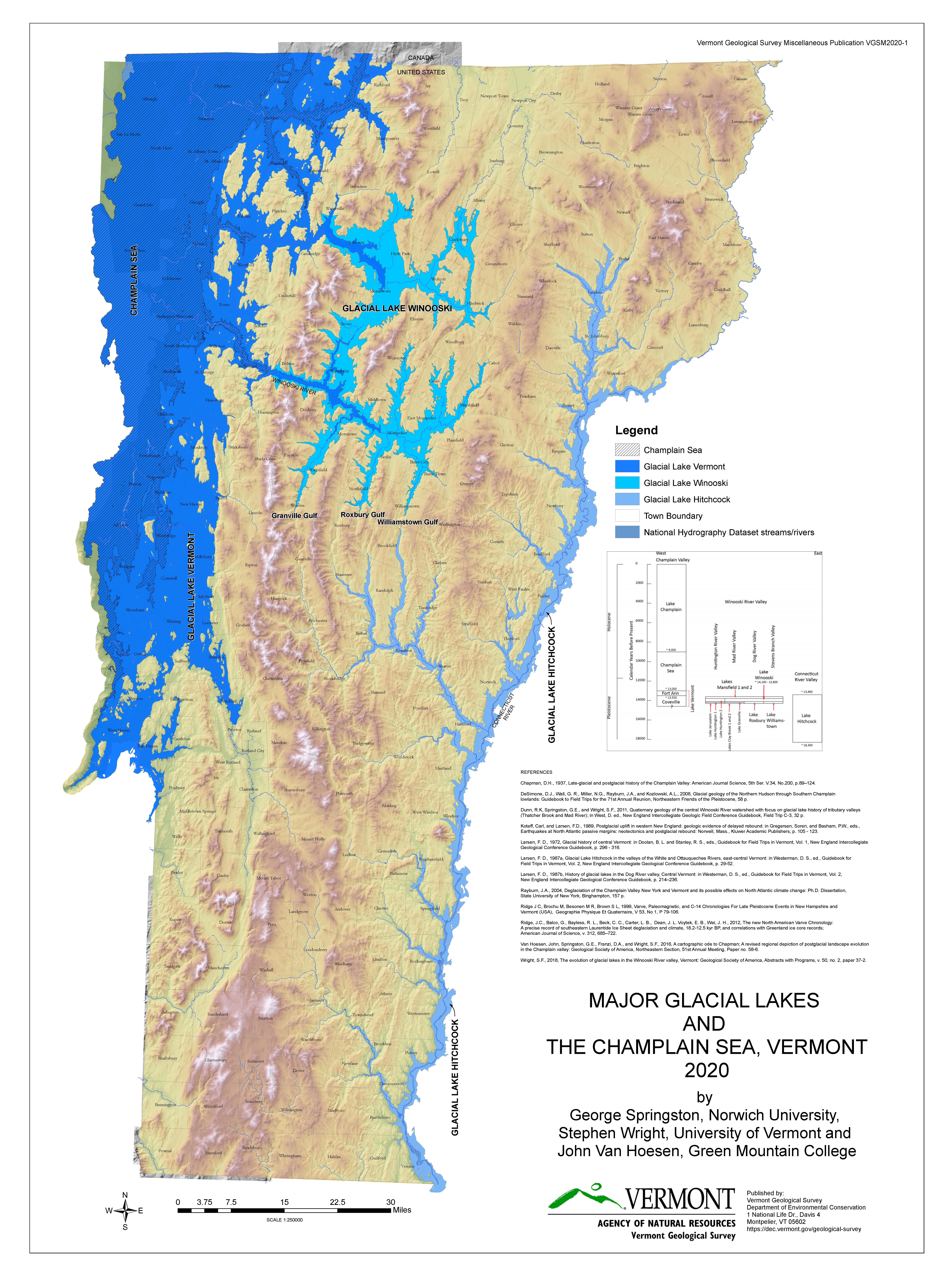
Major glacial lakes and the Champlain Sea, by George Springston (Norwich University), Stephen Wright (University of Vermont), and John Van Hoesen (Green Mountain College) via Vermont Department of Environmental Conservation. https://dec.vermont.gov/vermont-geological-survey/explore-vermont-geology
Even with the glacier completely gone, glacial forces continued to change the landscape. The land that had been compressed by the Laurentide Ice Sheet for thousands of years slowly rebounded and rose hundreds of feet. This movement severed the Champlain Sea’s connection to the ocean. Without ocean saltwater inflow, the Champlain Sea shrank, slowly filled with freshwater, and became Lake Champlain!
After spending thousands of years hidden under ice and water, the erosion-resistant bedrock ridges that survived glacial forces began to emerge as the body of water decreased in volume. The ancient seafloor of the Iapetus Ocean finally reappeared as dry land; becoming the Champlain Islands we know today!
Want to see the ancient past of the Champlain Basin up close? Visit the Lake Champlain Basin Program’s Resource Room at the ECHO, Leahy Center for Lake Champlain! Explore real fossils from the time when the region was a tropical reef, trace the retreat of the Laurentide Ice Sheet, and see how Glacial Lake Vermont and the Champlain Sea once covered the land. With maps and books that show the Basin’s dramatic transformation over time, it’s a perfect way to dive deeper into the region’s rich geological story and see how it impacts us today. Learn more about the geology and history of the Champlain basin online through the LCBP’s Atlas: https://atlas.lcbp.org/nature-environment/geology/
To see the exposed bedrock and the unique geology of the Islands in action, visit the Chazy Fossil Reef National Natural Landmark on Isle La Motte! Fisk Quarry Preserve and Goodsell Ridge Fossil Preserve provide access to see fossilized sea creatures from 480 million years ago. Fisk Quarry preserve is open year-round and features a short interpretive trail, while Goodsell Ridge Fossil Preserve features a visitor center and miles of trails.