Studying the feasibility of a “treatment train” to remove phosphorus from streamflow in the St. Albans Bay Watershed
Project summary
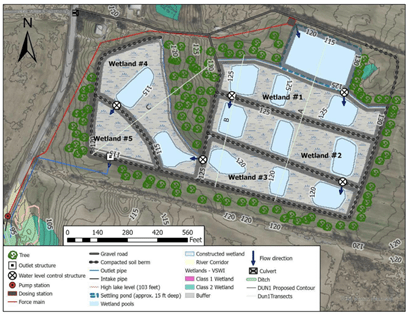
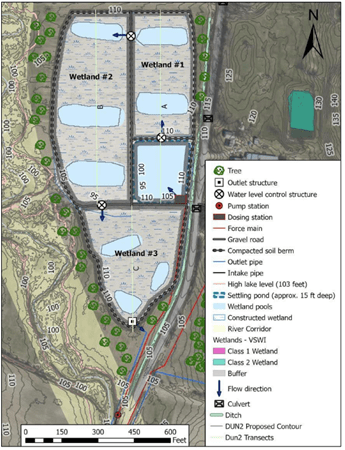
A Stone Environmental research team conducted a study to determine the feasibility of building a “treatment train” facility that would remove phosphorus from stream water before it enters St. Albans Bay. The treatment train would divert streamflow to settling basins, where phosphorus removal could occur through physical, biological, and chemical processes. The proposed designs for the Jewett Brook treatment train were modeled after an existing treatment train facility on Coldwater Creek, a tributary of Grand Lake St. Marys in Ohio.
Potential sites along Jewett Brook were evaluated for suitability, and two sites were determined to be most viable. The team used existing water quality, streamflow, and lake level data to determine likely influent concentrations, estimate removal efficiencies, and determine what times of year the facility could be operable. The team also investigated concerns regarding wetlands and fisheries associated with this potential facility and estimated capital and operations costs. An analysis of alternatives identified what phosphorus reductions could be achieved with equivalent investments to implement best management practices in the watershed.
Key results
- The team estimates that the treatment train facility could remove an average of 286 kg of phosphorus per year, which is approximately 7.5% of the annual average phosphorus load entering St. Albans Bay from Jewett Brook.
- The cost per kilogram of P removed is estimated to be $800, making this a relatively expensive phosphorus reduction approach compared to other practices.
Other takeaways
-
- Although the relative cost per mass of phosphorus removed is higher than other practices, the treatment train approach may result in water quality benefits that are more reliable and easier to quantify.
- Alterations to flow regime, impingement of fish and fish larvae, and increased water temperature are concerns of note for this type of work. Efforts to reduce the potential negative impacts on the stream and stream biota were included in the design considerations.
- Work to potentially develop a treatment train in this area is ongoing.