Riparian Buffer Establishment for Reed Canary Grass Control
Project summary
Well-established populations of invasive reed canary grass (RCG) have compromised the success of riparian forest restoration work in the northeastern United States because the plant outcompetes native plants, impedes tree establishment, and alters soil moisture dynamics. Herbicide application is a commonly used strategy for RCG management but has negative impacts on water resources. In response to this challenge, a team of researchers at the University of Vermont designed a study to determine if herbicide-free management alternatives were viable. The study included two types of treatment:
- Treatment A: herbicide-free till and mowing
- Treatment B (conventional management): glyphosate herbicide application with till and mowing
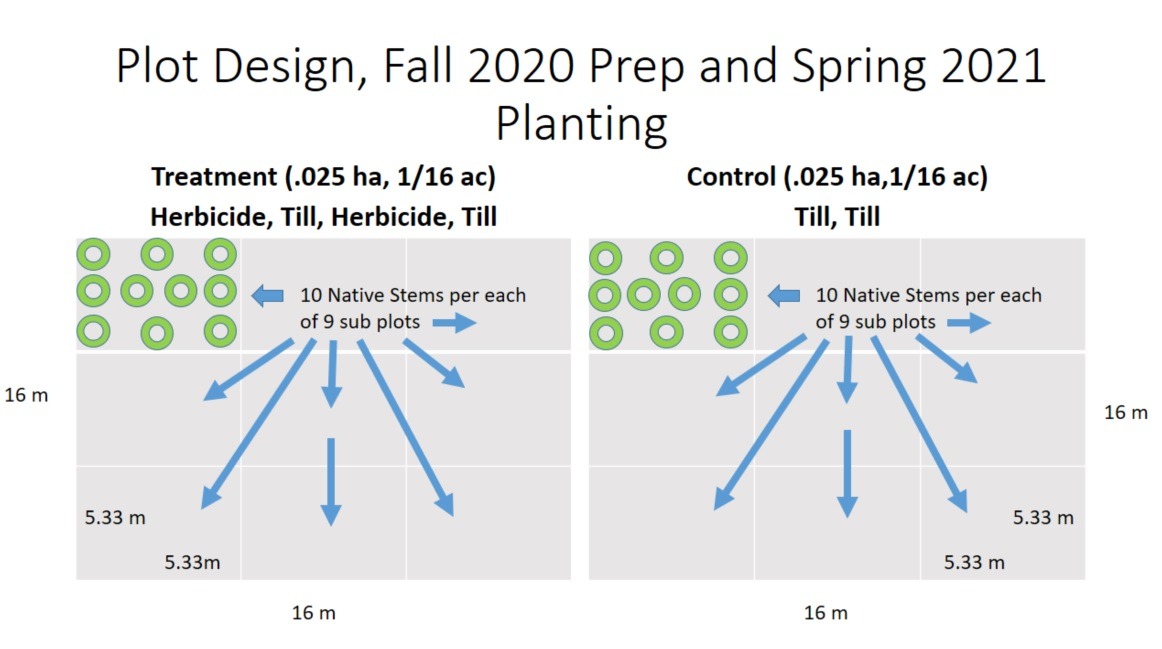
In collaboration with the Vermont Fish and Wildlife department, eight study sites were selected within Wildlife Management Areas in the Champlain Valley. At each site, a 0.05-hectare plot was established and divided into two adjacent subplots. Each subplot was further subdivided into a grid of nine squares to facilitate the collection of data including a count of living and dead stems, estimation of RCG percent cover, and analysis of covariance.
Two pre-planting treatments were completed at each site in the fall months. Treatment A plots were mowed to remove RCG then received two rounds of tilling, 16-days apart. Treatment B plots were also mowed to remove RCG, and two rounds of herbicide application occurred a week ahead of each tilling treatment. In spring of the following year, the plots were prepared for planting by installing rubberized weed retention fabric on the border of the Treatment A and Treatment B plots to prevent grass and rhizome migration between treatments, and flags were placed to designate the subdivisions of each subplot (Figure 1).
Key results
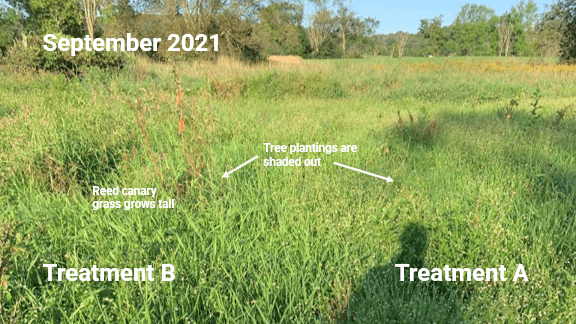
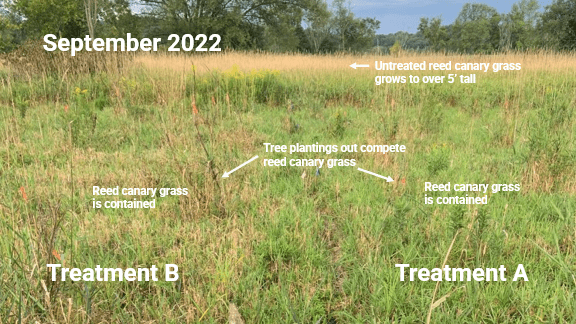
- The non-herbicide method was more effective at RCG management than the conventional herbicide method. RCG cover decreased 3.7% in Treatment A subplots between year one and year two of this study, whereas RCG cover increased by 9.5% in Treatment B subplots, which deviates from previous work.
- Survivorship of tree stems was higher in year one than in year two for both treatments. However, the survivorship of tree stems in all plots during the first year were comparable to previous studies, whereas survivorship in Treatment B (herbicide-applied) in year two was higher than a comparable study using herbicide and plow methods by Hovick and Reinartz (2007). This suggests that adding mowing to conventional herbicide and till methods increases tree stem survival.
Other takeaways
- Herbivory and girdling can be significant causes of mortality in restoration plantings but were not prevalent causes of mortality in this study. The researchers theorize that controlling the density of RCG reduced the habitat within the plots (relative to untreated surrounding areas) conducive to mole, vole, and other rodent species that girdle stems, which could have contributed to the lack of girdling-related mortality within the plots.
- The reduction of RCG in plots treated without herbicide was unexpected. It was observed that invasive bird’s-foot trefoil (Lotus corniculatus) established a dense surface cover on the Treatment A (non-herbicide) plots, likely due to more frequent mowing at these sites. The research team hypothesized that the dense ground cover could have prevented the excessive establishment of RCG in the non-herbicide plots compared to the herbicide-treated plots. This identifies a need for future work on cover cropping and its effect on RCG.