Are mudpuppies really salamanders?
Yes, mudpuppies are salamanders—with some special characteristics.
Spring is a great time to see many species of salamander—including the iconic yellow-spotted salamander—on the move as they migrate to vernal pools to breed. But there’s one species you won’t find while walking in the woods in the spring, because of a fundamental difference in its biology. The mudpuppy is our region’s only completely aquatic salamander, spending its entire life underwater.
While all salamander larvae have gills, only a few species maintain them into adulthood. One notable example is the axolotl, native to the high-altitude lake system of the Mexican Central Valley. Despite their prevalence in internet culture, wild axolotl populations are declining.
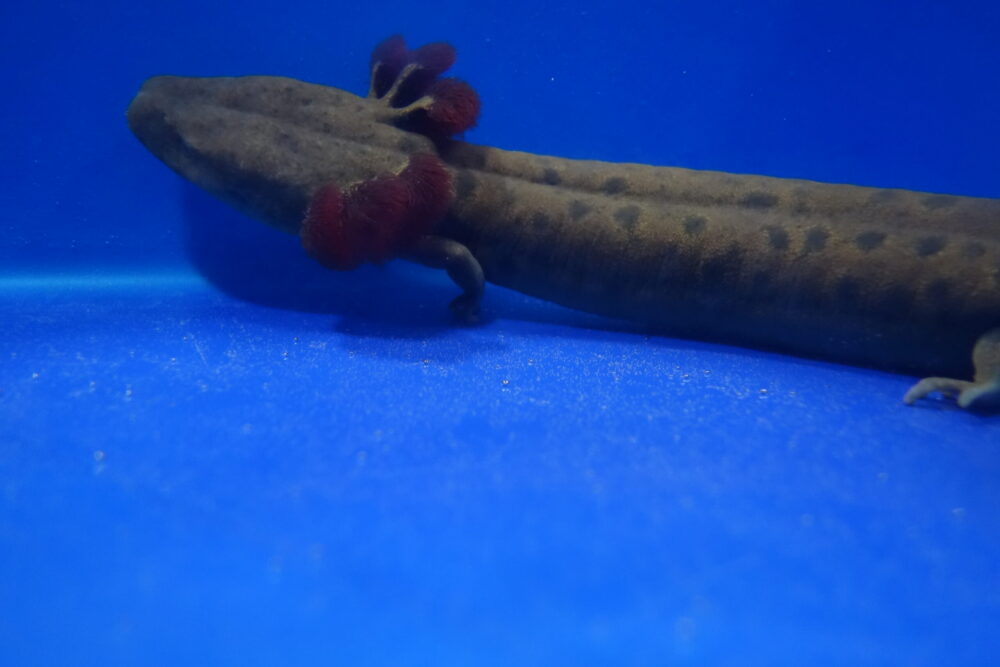
The mudpuppy is like our region’s axolotl (they just aren’t a Minecraft mob… yet). Their red gills give them away, as does their size: adults average 13 inches in length, making them our watershed’s largest salamander! Also referred to as a water dog, the mudpuppy’s name (and nickname) stems from their squeaky vocalizations, which sound to some like a dog’s bark.
Mudpuppies live at depths up to 60 feet in Lake Champlain and move upstream or into shallower areas to lay their eggs. They seek shelter under rocks and logs during the day and forage for aquatic insects, crustaceans, small fish, and even other salamanders by night. In turn, some fish, snapping turtles, herons, and crayfish are predators of the mudpuppy. Mudpuppies remain active throughout the winter—they continue foraging for food in the lake and tributaries even after ice forms.
In Vermont, the mudpuppy is considered a Species of Greatest Conservation Need owing to declining habitat and impacts from sea lamprey treatment in rivers. More research is needed to understand the threats facing mudpuppies.
The state’s largest population lives in the Lamoille River. From 2022 to 2023 the Vermont Department of Environmental Conservation in partnership with Vermont Fish and Wildlife Department carried out a LCBP-funded relocation effort aimed at re-establishing a new subpopulation in the Lamoille River, upstream of the Arrowhead Mountain Dam. Researchers captured mudpuppies below the dam and released them upstream, implanting radio tags in a subset of individuals to track their movement after release. To the research team’s knowledge, this was the first study to use this tracking technique to monitor mudpuppy movement.
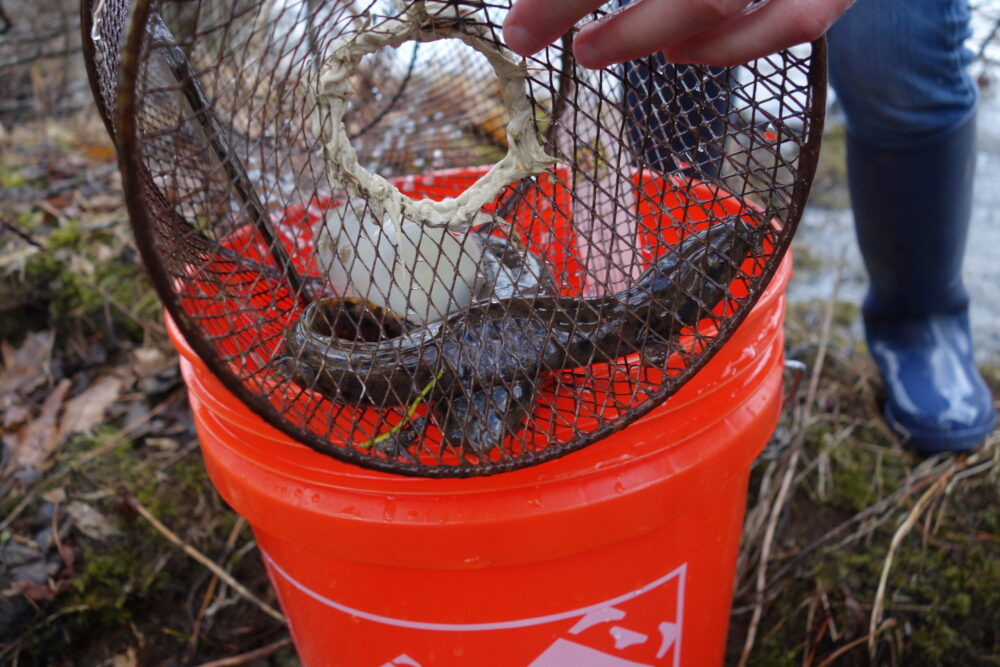
The research grant through the LCBP formally concluded in 2024, but follow-up efforts have added important takeaways to the project. In March and April of 2025 researchers set traps again, this time to determine whether any surviving mudpuppies could be detected in the area where they had been relocated.
Eight individual mudpuppies were caught over a two-week period. This was more than the biologists expected to find, and all individuals had grown in size. The oldest recaptured individual had been relocated five years prior. While the effort was not designed to estimate the number of surviving mudpuppies or make projections about future population viability, researchers are optimistic about the mudpuppies’ odds for survival.
How can you help the mudpuppy? If you’re lucky enough to encounter one in the wild, take a moment to marvel at its bright red gills, but leave it be. Report your sighting to the Vermont Reptile and Amphibian Atlas, a project to collect and disseminate data that can inform reptile and amphibian conservation.
Since mudpuppies are sensitive to pollution, you can also take action to help keep water in Lake Champlain and its tributaries clean. Always pick up pet waste, properly dispose of hazardous waste, protect and plant native plants along shorelines and riverbanks to reduce erosion, install a rain barrel, or volunteer with a local watershed organization.