2026 Lake Champlain Research Conference Summary
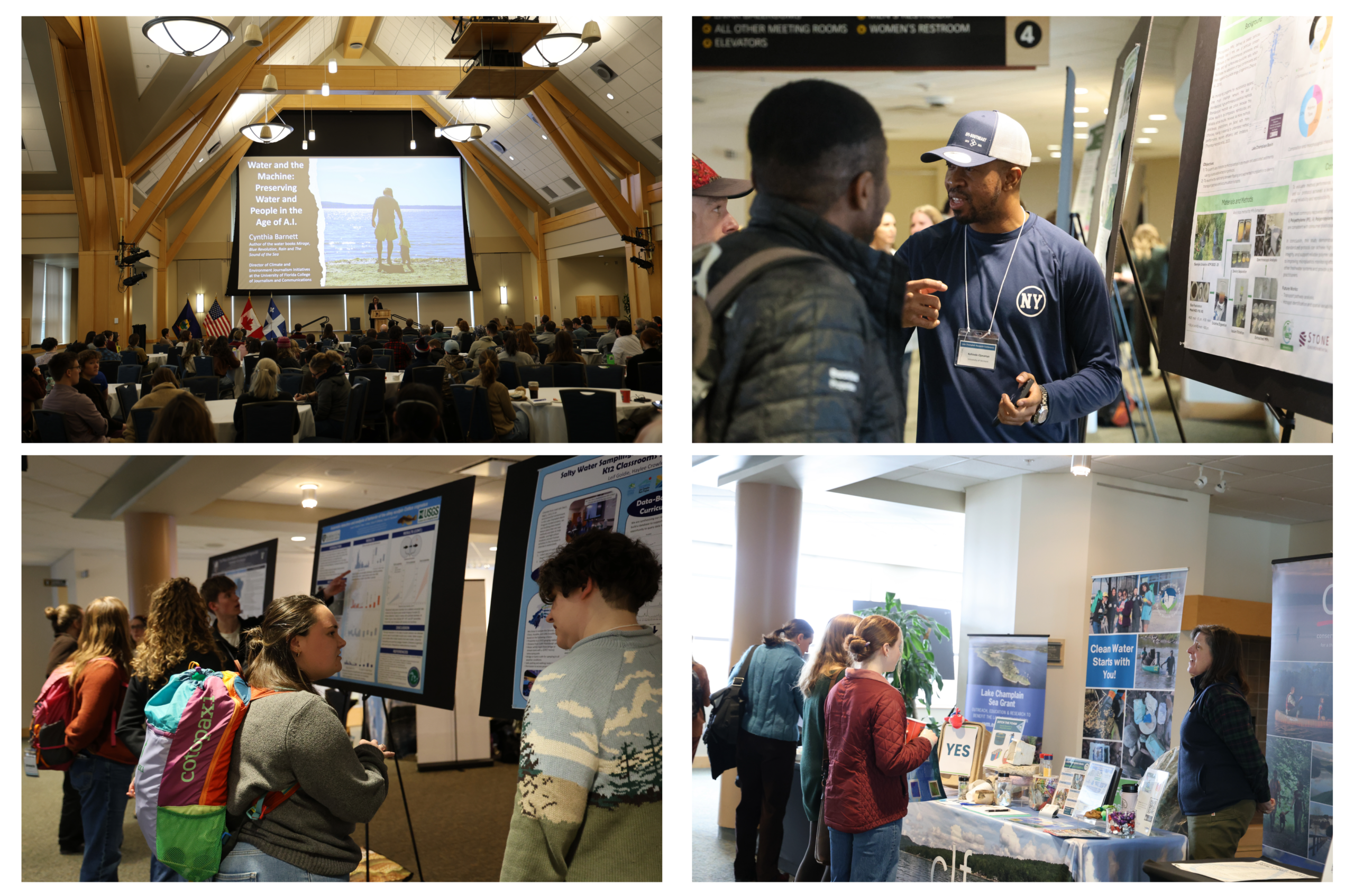
The 2026 Lake Champlain Research Conference was held on January 26th-27th at the University of Vermont Davis Center. Over two days, we welcomed 334 attendees to the conference in-person and online, including attendees from New York, Vermont, Québec, New Hampshire, Maine, Massachusetts, New Jersey, and Florida. There were 82 oral presentations, 39 posters, 6 exhibitors, 2 panels, and 2 keynote addresses. Topics covered a wide array of Lake Champlain centered work, including the impacts of de-icing salt, flood resilience, aquatic invasive species, community science programming, agriculture, regional history and culture, and science communication. Though we are no strangers to winter weather here in the northeast, the 15 inches of snow that fell in Burlington, VT, before the first morning of the conference certainly made for an eventful start!
These three presentations demonstrate the breadth of work presented at the 2026 Research Conference:
- Uniting for Clean Waters: A Community Coalition Approach to a Foam-Free Lake Champlain Basin – Aude Lochet, Lake Champlain Sea Grant at SUNY Plattsburgh
- The Lake Champlain Basin Marine Debris Coalition (LCBMDC) seeks to increase community awareness of and reduce the presence of marine debris, especially plastic foam, in the Lake Champlain Basin. In 2025 alone, the LCBMDC held 13 cleanups with 450 volunteers engaged, reached 12 teachers and 200 youth through youth education engagement, and provided technical assistance for the proper removal and disposal of dock floats.
- Goals of the program include:
- Improved ability of organizations to provide marine debris education;
- Increased number of young people engaged in minimizing sources and pathways of marine debris;
- Reduced marine debris pollution from lakeshore businesses and property owners by altering product use
- Challenges facing Québec’s efforts to reduce phosphorus losses to the Missisquoi Bay Watershed – Louis Robert, Organisme de bassin versant de la baie Missisquoi
- The Agricultural Operations Regulations of 2002 in Québec (QC) require farms to produce an annual balanced phosphorus budget; however, subsidies and regulations have had limited results in P reduction. P soil content in southern QC is about twice that of Vermont.
- The ineffectiveness of these regulations is largely due to a gap between the current state of knowledge and the best management practices that are promoted by extension and government.
- Regulations focused on total phosphorus and not on dissolved reactive phosphorus.
- In the short-term, riparian buffer strips may reduce the loss of particulate P by reducing runoff. However, in the long-term, they could increase losses of dissolved reactive phosphorus and total phosphorus by as much as 200%.
- Most phosphorus losses occur through tile drains.
- Tools for Data-Driven Decision Making in Invasive Species Management – Mitchell O’Neill, New York Natural Heritage Program and SUNY-ESF
- This presentation provided an overview of invasive species management tools available to natural resource managers in New York, the Lake Champlain Basin, and beyond.
- The impacts of invasive species in the basin are abundant and costly to address- often requiring management actions to be prioritized.
- Tools such as iMapInvasives, allow professionals and citizen scientists to report observations of invasive species that are reviewed by taxonomists. The robust GIS-based database allows for species tiers, conservation value, as well as the risk of introduction, establishment, and spread to be scored at a regional level, which can be used to prioritize species, locations, and management practices for greatest impact.
If you are interested in seeing more of the work presented at this year’s conference, many of the slide decks associated with oral presentations are available on LCBP’s website at this link. If the presentation you are looking for is not available on our website, please reach out directly to the author/presenter for more information. The full conference agenda, including abstracts for each presentation, is available at this link.
We want to extend a huge thank you to all conference participants, presenters, and the keynote speakers, Cynthia Barnett and John Krueger. This event would not have been possible without the support of the Lintilhac Foundation, the Lake George Association, the Lake Champlain Research Consortium, the Great Lakes Fishery Commission, Adirondack Research, and the Davis Center Event Services team. The organization of this event was a collaborative effort between the Lake Champlain Basin Program/NEIWPCC, Lake Champlain Sea Grant, and the Water Resources Institute at the University of Vermont.