Meet the Scientist: Dr. Timothy Mihuc Takes the Helm of New SUNY Plattsburgh R/V Leptodora
Dr. Timothy Mihuc has studied Lake Champlain’s ecosystem from aboard the SUNY Plattsburgh R/V Gruendling for over twenty years.
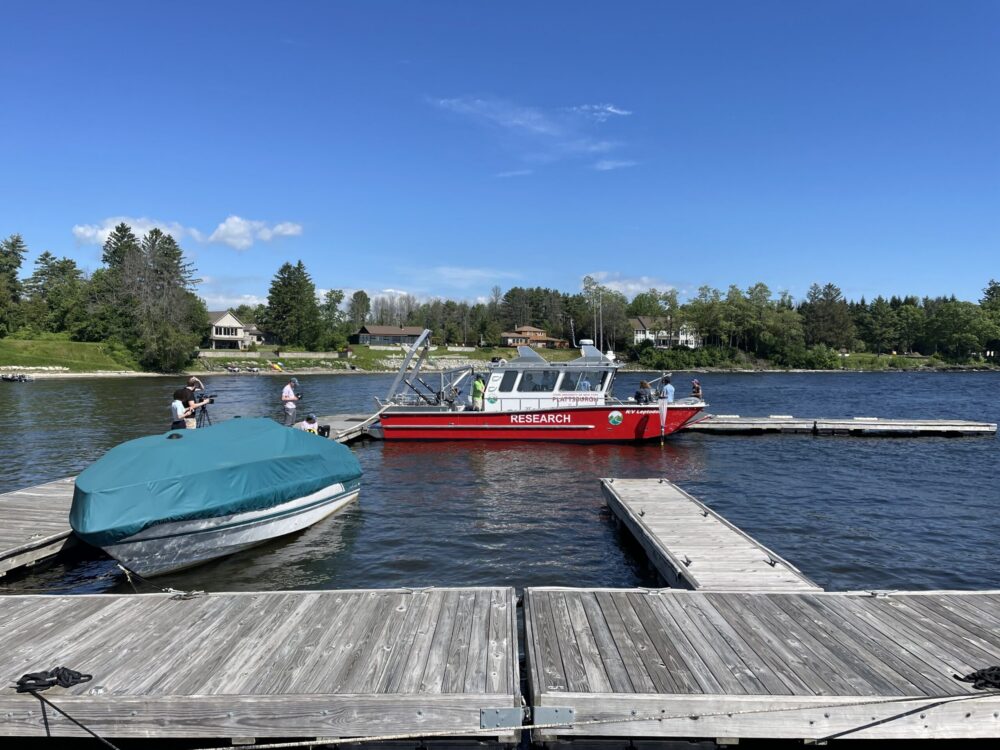
On June 9, partners gathered at the Valcour Inn and Boathouse to dedicate the new R/V Leptodora—a 36-foot, high-tech vessel named for a native planktonic predator found in Lake Champlain.
Mihuc serves as distinguished service professor in the Center for Earth and Environmental Science and director of the Lake Champlain Research Institute (LCRI). He’ll now helm the new research vessel and bring students aboard to learn and conduct research.
“The thing I enjoy most about my job at Plattsburgh is getting projects going, and then getting students involved in projects,” Mihuc shared in the LCBP’s latest Meet the Scientist feature.
The Great Lakes Fishery Commission (GLFC) provided $750,000 to replace the old vessel and committed $650,000 for a multi-year research effort. The LCBP and National Oceanic and Atmospheric Administration’s Sea Grant program provided additional funding for the design and construction.
With its larger size, increased power, and modern technology—like a side-scan sonar capable of mapping the lake floor—research opportunities both new and ongoing abound.
Mihuc is one of several scientists leading the Lake Champlain Long-Term Water Quality and Biological Monitoring Project (LTMP). The LCBP has funded the project since its inception in 1991, and SUNY Plattsburgh has been a central partner for over 25 years.
Each summer, field crews from SUNY and Vermont Agency of Natural Resources visit 15 lake sites and over 20 tributaries to measure key water quality parameters, including nutrients, carbon, plankton, and sediment. Data also comes from five data buoys maintained by LCRI and partners.
Over the lifetime of the project, the partnership has collected over 100,000 lake measurements and over 70,000 tributary samples. This vast dataset provides an essential foundation for understanding Lake Champlain’s water quality, ecosystem health, and long-term changes.

Mihuc and his team spent the month of May installing high-tech weather station buoys during test runs on the Leptodora. These buoys send out real-time data on weather and lake conditions. Accessible online, the information is used by students, scientists, and recreationists alike.
Dr. Matthew Vaughan, chief scientist for the LCBP, joined the team for the Malletts Bay buoy deployment in May.
“It was a joy to see this vessel work exactly as designed,” Vaughan shared in his remarks at the dedication ceremony. “It’s a true workhorse—capable, well-equipped, and ready for the work ahead.”
In his Meet the Scientist interview, Mihuc pointed to the long-term monitoring program—and his students’ involvement in it.
“Directions for the future for me as a scientist will probably be to make sure our monitoring program is on solid, stable ground, and that we’re contributing to that into the future,” Mihuc said.
He is also running a new study investigating the distribution of microplastics across the lake.
“It’s an environmental issue that I think we need to do a little more to try and figure out, and then tackle that problem in all waterbodies, including Lake Champlain,” said Mihuc.
The new R/V Leptodora, with its boundless possibility for inquiry and research, will support both long-term monitoring efforts and emerging research projects for years to come.
Through it all, the vessel will serve as a floating classroom for SUNY Plattsburgh students.
“The future scientists and managers of this lake in 20 years may well trace their careers back to their time spent on this vessel,” said Vaughan.
Watch all of the LCBP’s Meet the Scientist profiles here.