Celebrating 20 Years of the LCBP Boat Launch Steward Program
When Meg Modley launched the Lake Champlain Basin Program’s (LCBP) boat launch steward initiative in 2007, she supervised just four stewards tasked with preventing the spread of aquatic invasive species (AIS) into or out of Lake Champlain.
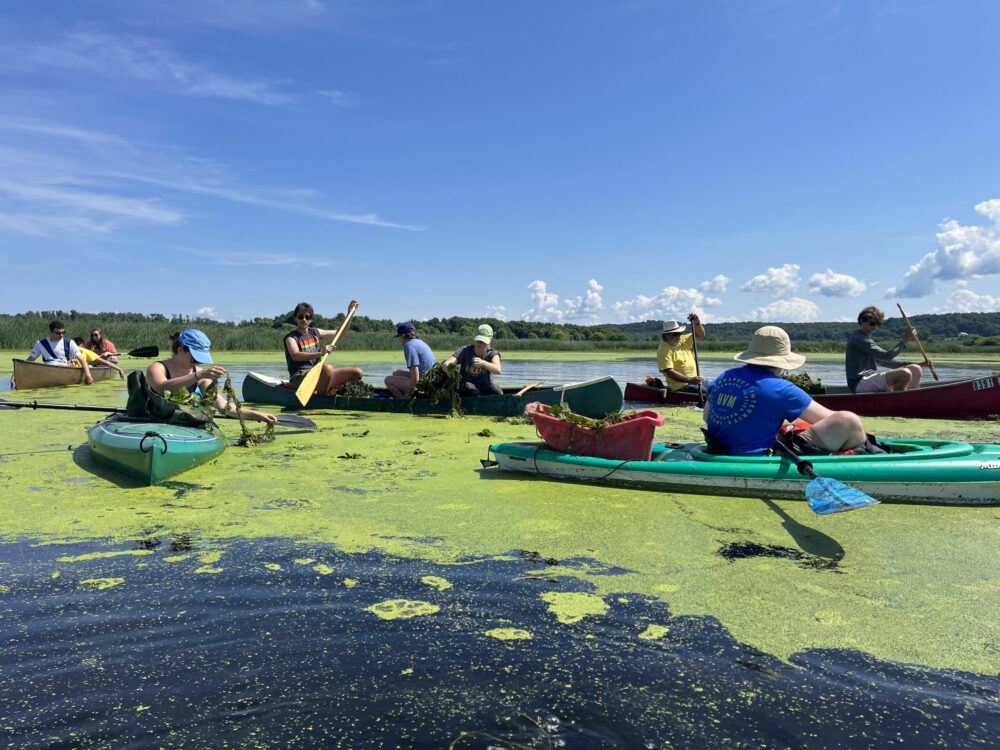
That’s no small feat on a lake with nearly 600 miles of shoreline and many points of entry for watercraft potentially carrying aquatic hitchhikers—invasive plants and animals that can devastate aquatic ecosystems once introduced.
But “we just started,” said Modley, who serves as the healthy ecosystems and AIS management coordinator for the LCBP and NEIWPCC. “We started with four stewards: two in New York and two in Vermont.”
Now in its 20th year, the program has grown substantially. This summer, 28 stewards will be stationed at 24 public access areas on the lake. They’ll inspect watercraft, offer decontaminations, and spread a core message: Clean, Drain, Dry.
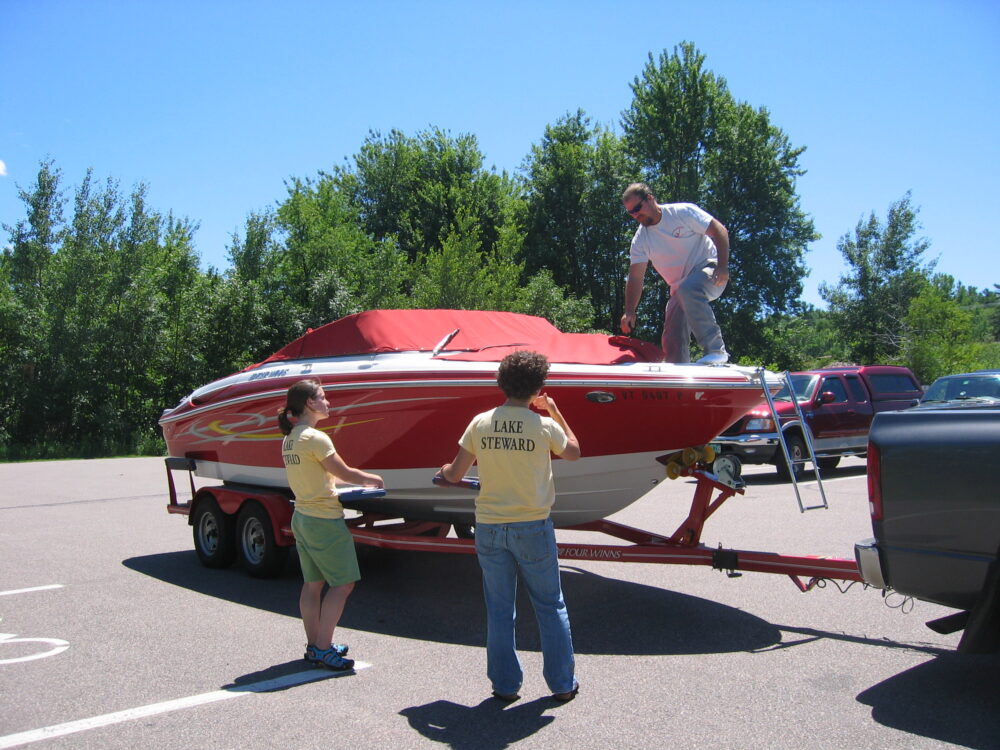
Today, many boaters on Lake Champlain know this saying and can anticipate the questions they’ll be asked: “Where did you last launch your boat? Did you take any spread prevention measures?”
While launch users are generally happy to engage, stewards are sometimes waved off by owners of “Lake Champlain-only boats”—shorthand for locals who only ever launch in Lake Champlain.
But whether boaters greet stewards warmly or with mild impatience, data shows that the familiarity is there—and that’s what counts. According to data collected by LCBP stewards between 2021 and 2023, 73% of boaters on Lake Champlain reported taking spread prevention measures when launching and retrieving their watercraft.
Additionally, no new AIS have been confirmed in Lake Champlain since 2018, despite numerous close calls over the years. In 2019, a steward intercepted hydrilla—a highly invasive plant “on the doorstep” of Lake Champlain—while working at the South Hero, Vermont John Guilmette access site. Several high-profile “saves” over the years have proven the program’s value and speak to one of Modley’s guiding principles: an ounce of prevention is worth a pound of cure.
But protecting surrounding water bodies from AIS established in Lake Champlain is equally important.
“We’ve had a number of invasive plant saves [on launch],” said Modley, “but the amount of material that we remove on watercraft exiting the lake that’s headed to uninvaded water bodies is probably more astonishing.”
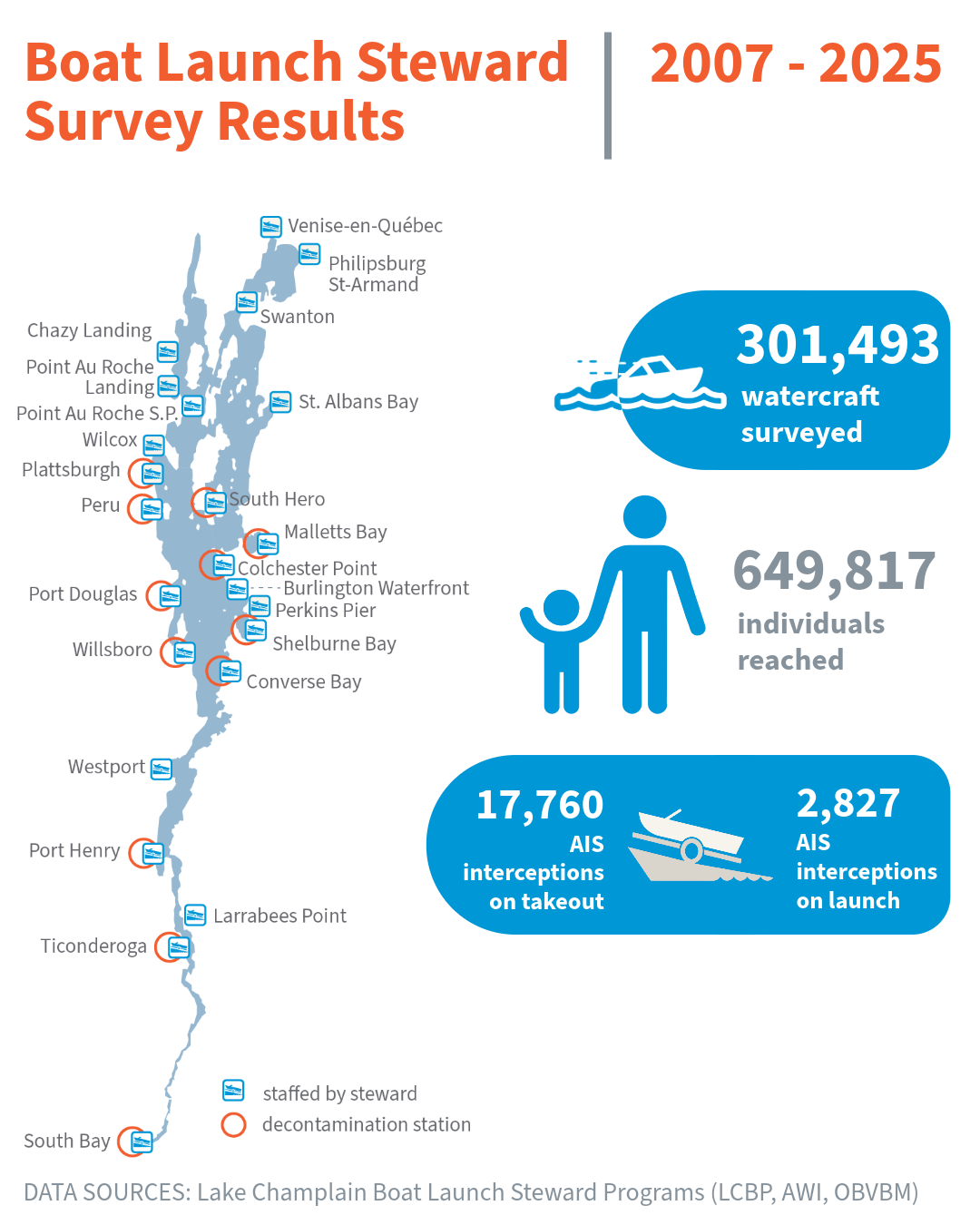
From 2007 to 2025, LCBP stewards intercepted over 20,000 aquatic invasive species, with more than 86 percent of interceptions from watercraft exiting Lake Champlain. As of 2023, 75 percent of lakes in the Adirondacks and 80 percent of lakes in Vermont were free of AIS.
The first steward programs in the basin were initiated by lake associations and towns in the Adirondacks, home to pristine lakes and ponds with no known AIS present. These early programs sought to protect the park’s waters from incoming AIS, but that thinking “quickly morphed into the concern about transferring species both in and out of water bodies,” said Modley.
As momentum built through the Adirondacks, adapting a steward model for Lake Champlain began to emerge as a clear priority. Within a few years, data collected by stewards spoke for the program’s value.
“We were pretty capable of demonstrating how many people we were interacting with, how many watercraft we were inspecting, what we were finding,” said Modley. “And the data has a very powerful message.”
Staff support and strong partnerships have continued to grow the program, even in recent years.
When Lauren Jenness joined the team in 2019, she began providing supervisory support to stewards, as well as oversight of data management.
In 2018, the New York State Department of Environmental Conservation (NYSDEC) awarded a five-year, $9.3 million contract to the Adirondack Watershed Institute (AWI) based at Paul Smith’s College. The contract, renewed in 2023, significantly expanded AWI’s watercraft inspection program and positioned the Institute as a central partner. Each year, LCBP stewards are trained alongside AWI stewards and spend two days on the Paul Smith’s campus learning to identify aquatic plants and operate decontamination units.
It’s no accident that boaters across the watershed hear the same messaging from stewards wherever they launch. The unified approach among partners has been core to the success of steward programs around the region.
In 2017, funding through the Great Lakes Fishery Commission allowed the LCBP and NEIWPCC to begin supporting stewards working in Québec through a partnership with Organisme de bassin versant de la baie Missisquoi. They collect the same data and deliver the same messaging as stateside stewards, but in French—reaching an important community of lake users.
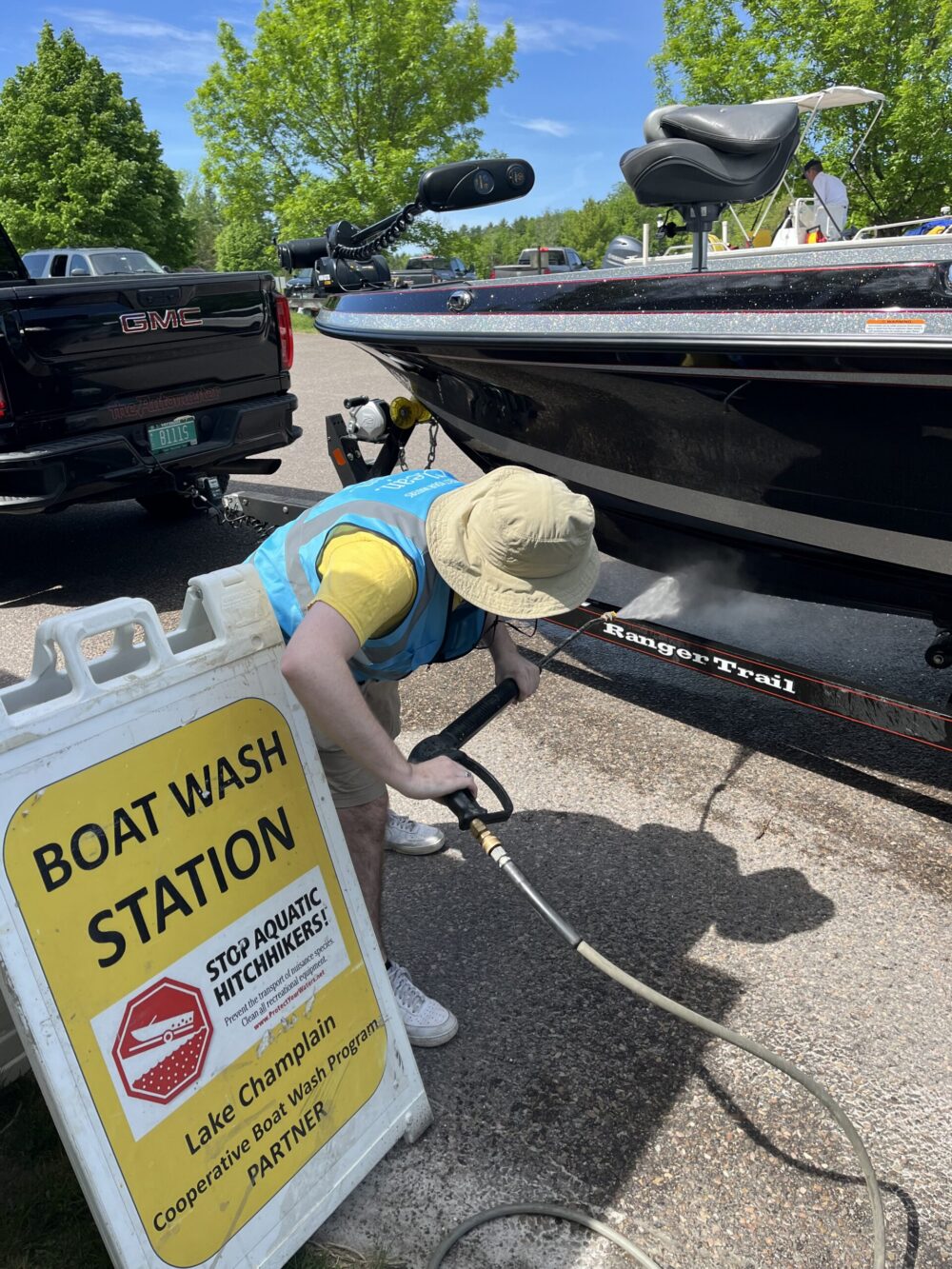
The number of launches with high-pressure, hot water decontamination units has grown, too, increasing stewards’ ability to reduce AIS transport.
Many stewards have moved into careers in the environmental field, including five stewards who have transitioned into full or part-time work with the LCBP. Of the five, three currently work on staff.
The role provides valuable experience: stewards learn about Lake Champlain’s ecosystem, gain a deeper understanding of AIS management, and hone skills in communication and public engagement.
In total, the LCBP and NEIWPCC have hired 133 stewards. Of those, 55 have come back for at least one additional summer, and 18 have completed three or more seasons.
Karla Rieger has served as a boat launch steward for 13 seasons. Rieger taught high school biology for nearly 30 years and retired in 2025. When school was out for the summer, she greeted boaters launching in Plattsburgh, New York. It quickly became clear that her experience as a steward could inform her teaching.
“I felt like I could incorporate some of this in my classroom,” said Rieger. “I did invasive species projects and the kids really liked it. It hit home because Chateaugay Lake started to get invasives, and a good majority of the student population had a connection to [the lake].”
Whether connecting with one of her students or a boater getting ready to launch, Rieger is always excited when people learn something new—and take action.
“I would say my biggest reward is seeing people who’ve heard my message and say, ‘Hey, Karla, I washed my boat when I went to a different lake.’”
This behavior change adopted at scale across the boating community is the shoot-for-the-moon goal of the boat launch steward program.
One interaction at a time, boat launch stewards are helping boaters become stewards in their own right—protecting our shared waters well into the future.