Phosphorus removal in tile drain baseflow using St. George Black
Project Summary
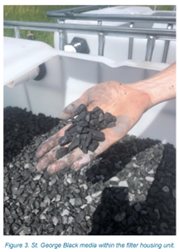
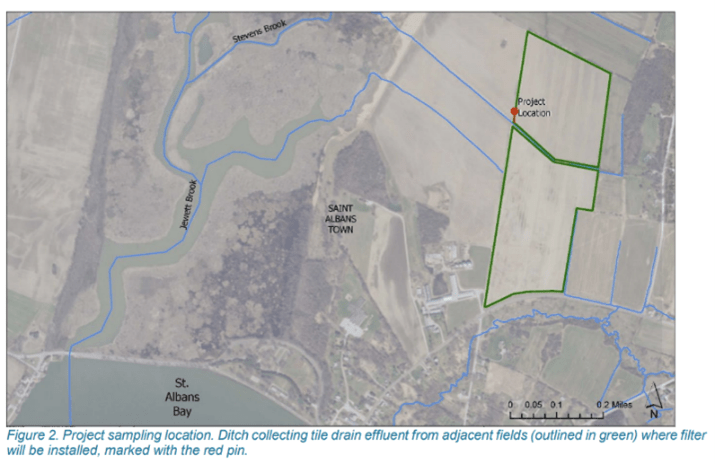
A research team from Watershed Consulting Associates evaluated the efficacy of locally sourced shale material called St. George Black (SGB) as an adsorptive media to remove phosphorus during low-flow conditions on tiled agricultural fields in St. Albans, VT (Jewett Brook-St. Albans Bay Watershed).
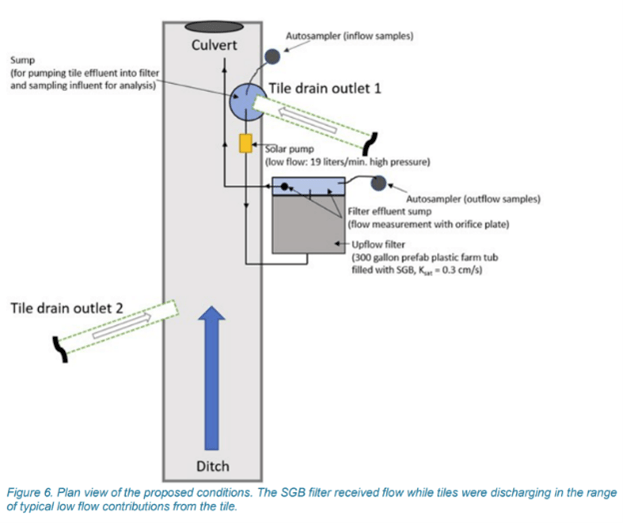
The filter unit was installed adjacent to a ditch between two tile drained fields. A solar powered pump collected effluent from the tile and delivered it to the filtration unit filled with SGB material, and discharged the outflows back into the ditch. Samples were collected at the inlet and outlet of the filter unit to evaluate phosphorus removal efficiency.
Key Results
- Data taken over the two years demonstrates overall reductions of total phosphorus (46.3%), total dissolved phosphorus (50.1%), and soluble reactive phosphorus (57.1%) in outlet samples compared to inlet effluent.
- Percent reduction of phosphorus remained consistent throughout the duration of the study, indicating that SGB has a longevity of at least 2 years as a filter material at this site.
Other takeaways
- Minimal maintenance is required on SGB filters, which could be well suited for use on agricultural farms where landowners have limited capacity for maintenance of filters.
- Can be scaled up for higher flows by diverting flows into a basin with an outlet control to reduce flow rate through the filter unit.
- Proper disposal of used SGB filter material may be a challenge.