Efficacy of the 2017 Vermont Stormwater Management Manual Bioretention Soil Specification in removing pollutants and supporting plant health
Project Summary
Bioretention is a type of stormwater management that uses engineered soil media and vegetation to store, infiltrate, and filter pollutants, such as nutrients and heavy metals, out of stormwater runoff. Though bioretention is commonly considered a best management practice for stormwater management, studies have found that certain soil media, particularly media high in organic material like compost, can export nutrients like nitrogen and phosphorus (P) in their effluent. To address this concern, the 2017 Vermont Stormwater Management Manual updated the specifications for soil media to reduce the compost content. However, the reduction in organic matter content in soil media created concern that the resulting stormwater effluent may not have the nutrient contents to be suitable for sustaining plant life.
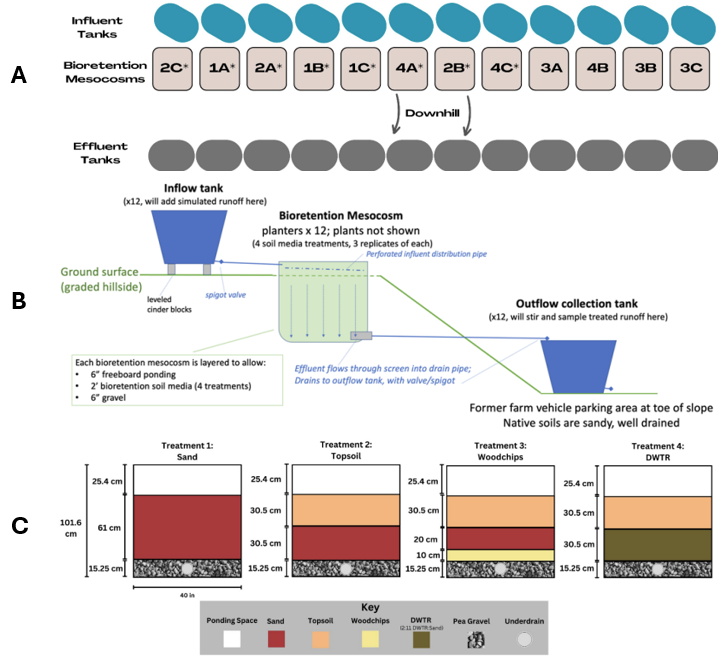
A team from Stone Environmental and the University of Vermont (UVM) analyzed different compositions of soil media for their efficacy in removing sediment, nutrients, and heavy metals from stormwater while simultaneously maintaining capacity to sustain plant life. The experimental bioretention mesocosm was set up at the UVM Horticulture Research and Education Center in South Burlington, VT. The mesocosm design consisted of three main components flowing downstream: the inflow tank, bioretention mesocosm, and effluent tank (Figure 1B). Four treatments were tested, each repeated three times, for a total of twelve mesocosms (Figure 1A, C).
- Treatment 1 (control): Medium sand with low-P compost applied at plant root zone, followed by a sand-only layer and pea gravel at the bottom
- Treatment 2: low-P topsoil with low-P compost applied at plant root zone, followed by a sand-only layer and pea gravel at the bottom
- Treatment 3: low-P topsoil with low-P compost applied at the plant root zone, followed by a sand-only layer, a fresh hardwood woodchip layer, then pea gravel at the bottom
- Treatment 4: low-P topsoil with low-P compost applied at the plant root zone, followed by a sand-only layer, a layer of sand mixed with aluminum-based drinking water treatment residuals, then pea gravel at the bottom
In addition to monitoring a few natural rainfall events throughout the duration of study, simulated stormwater runoff events were used to test the bioretention mesocosms against a variety of stormflow and pollution levels. To create simulated storms with varied “rainfall depth” and pollutant levels, inflow tanks were filled with 30, 60, or 90 gallons of well water mixed with one liter of a concentrated pollutant solution. The pollutant solution had three different concentrations: 1X, 2X, and 4X. At the start of each natural and simulated event, an influent grab sample was collected. Effluent water samples were collected following events. Water samples were analyzed for nitrate, soluble reactive phosphorus, total nitrogen, total P, and heavy metals. Vegetation health was evaluated by monitoring three metrics: vegetation coverage, plant height, and plant survival counts.
Key Results
- The mean effluent concentration of nitrate exceeded the mean influent concentration for all treatments except Treatment 3 (with a woodchip layer). Total nitrogen concentrations were higher in effluent than influent for nearly all samples. The increase in nitrate could be attributed to leaching of nitrate from the low-P compost applied to plant roots in all mesocosms.
- In all treatments, mean P (soluble reactive and total P), zinc, and copper concentrations were reduced in effluent compared to influent. Mean P removal was comparable for all treatments except Treatment 3, which was less effective.
- The use of low-P topsoil in soil media as the primary form of organic matter supporting vegetation health was very successful, supporting vigorous and healthy plant growth.
Other Takeaways
- Heavy metals removal was comparable for all treatments.
- Sand treatment mesocosms (Treatment 1) performed poorly in vegetation health metrics, while the topsoil treatment mesocosms (Treatments 2-4) generally appeared healthier.
- The inclusion of woodchips resulted in reductions of nitrate in bioretention effluent, but concern over the release of P from woodchips makes further research necessary before woodchips should be recommended as a material in bioretention systems.
- This study did not find any significant differences between mesocosms that included drinking water treatment residuals in the sand layer and those that did not. However, previous studies have found that drinking water treatment residuals can be effective in sorbing P.
Read the full technical report here.