Evaluating filters to remove phosphorus from stormwater pond outflow
Project summary
A research team from Stone Environmental piloted four identically designed filters, each containing a different mixture of material, to remove phosphorus (P) from the outflow of a stormwater pond. The Dorset Park stormwater pond discharges to a tributary of Potash Brook in South Burlington and was chosen for this study due to its relatively high total dissolved P (TDP) concentrations. All four filters contained Swanton black shale, a locally sourced media that was previously found to be effective in the removal of TDP and total P (TP) from tile drain outflows (Braun 2023). Three of the filters blended additional material to the black shale, including activated alumina granules, zero-valent iron shavings, and alum-based drinking water treatment residuals. The fourth filter contained only black shale, acting as an experimental control.
The filters were constructed in a row aligned with the pond’s outlet structure along the edge of the stormwater pond. Each filter was 10 ft by 7 ft and filled with approximately 6 cubic yards of material. Two perforated intake pipes conveyed pond water into the filters, where water would flow through the filter via another perforated pipe. Treated water flowed via gravity into a collection pipe, through a monitoring manhole, and to the outlet structure (Figures 1, 2). Sampling visits were conducted weekly and after rainstorms at the stormwater pond filter inflows and outflows between March 2022 and December 2022.


Key results
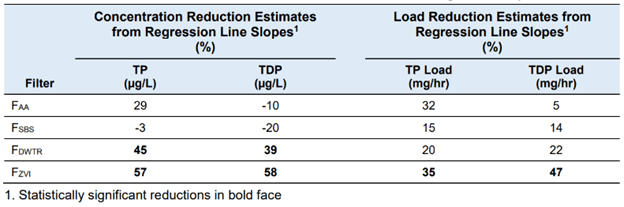
- Significant decreases in TP and TDP concentrations between inflows and outflows were found for the filters containing drinking water treatment residuals and zero valence iron. Significant decreases in TP and TDP loads were measured for filters containing zero valence iron (Table 1).
- Higher inflow TP and TDP concentrations resulted in greater P reduction at all flow rates, especially for filters containing drinking water treatment residuals and zero valence iron.
Other takeaways
- Water temperature changed over the course of the monitoring period with changing air temperatures but did not vary significantly between the inflow and outflow.
- pH at the inflow did not vary significantly over the monitoring period, but pH was greatly reduced in the filter outflows for all four filters. This effect was particularly strong for the activated alumina filter, which often had outflows with pH values that were below Vermont Water Quality Standards.
Read the full technical report here.